Unlock Massive Revenue: 7 Proven Strategies for ADX for WordPress in 2026
Introduction: Why ADX for WordPress is a Game-Changer
In the ever-evolving landscape of digital publishing, monetizing your WordPress website effectively is paramount. While Google AdSense has long been the go-to for many, the true potential for maximizing ad revenue lies with ADX for WordPress. Google Ad Exchange (AdX) offers a premium marketplace where advertisers bid in real-time for your ad inventory, often leading to significantly higher earnings compared to AdSense. This comprehensive guide will delve into the intricacies of integrating and optimizing ADX for WordPress, ensuring your site is not just approved, but thrives in the competitive ad tech ecosystem of 2026.
Table of Contents
Understanding Google AdX vs. Google AdSense for WordPress Publishers
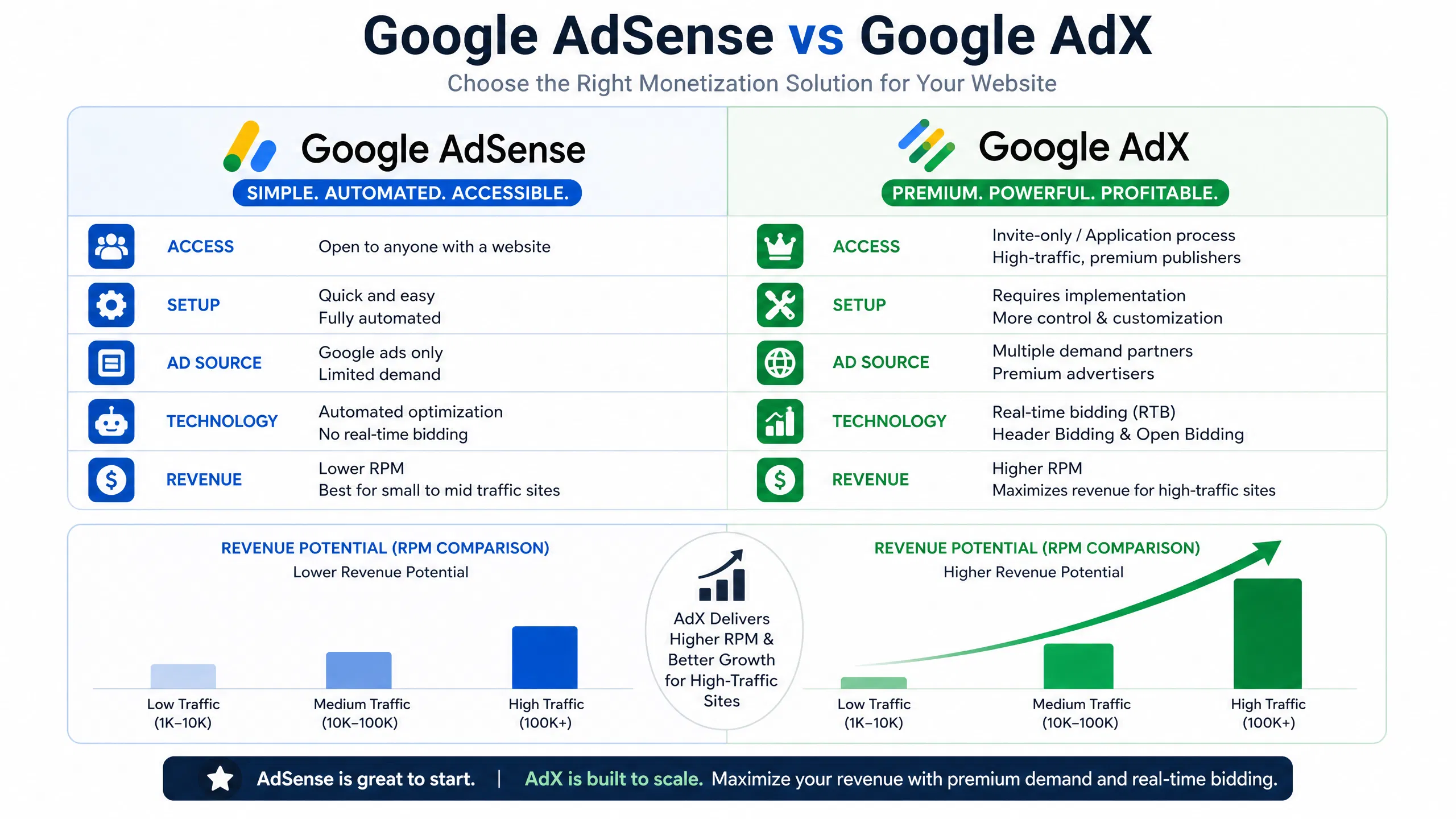
Before diving deep into ADX for WordPress, it’s crucial to understand its distinction from Google AdSense. Both are Google products designed for publishers to earn revenue, but they operate on different scales and offer varying levels of control and earning potential.
Google AdSense is a simpler, more accessible platform, ideal for small to medium-sized websites. It automates ad placement and serves ads from Google’s vast network of advertisers. The entry barriers are low, making it a popular starting point for new WordPress sites looking to monetize .
Google AdX, on the other hand, is a premium ad exchange. It’s an invite-only marketplace where multiple ad networks and demand-side platforms (DSPs) compete in real-time bidding (RTB) for your ad impressions. This increased competition typically results in higher eCPM (effective cost per mille) and overall revenue for publishers. While AdSense is a direct ad network, AdX acts as an ad exchange, facilitating a more dynamic and competitive auction environment .
Here’s a quick comparison:
|
Feature
|
Google AdSense
|
Google AdX
|
|
Access
|
Open to almost any website
|
Invite-only, typically for high-traffic, premium publishers
|
|
Setup
|
Simple, automated
|
More complex, often requires an AdX partner or ad operations expert
|
|
Ad Source
|
Google Ads network
|
Multiple demand partners, real-time bidding, header bidding
|
|
Revenue Potential
|
Lower RPM, suitable for small/medium sites
|
Higher RPM, maximizes revenue for high-traffic sites
|
|
Control
|
Limited control over ad types and pricing
|
Granular control over ad inventory, floor prices, and blocked categories
|

The Unbeatable Benefits of ADX for WordPress
Migrating to or integrating ADX for WordPress offers a multitude of advantages for publishers seeking to significantly boost their monetization efforts. The primary benefit is, without a doubt, increased revenue. Publishers often report a 20-50% increase in ad revenue when moving from AdSense to AdX, especially for traffic from Tier 1 countries .
Beyond higher earnings, ADX provides:
•Enhanced Competition: By opening your inventory to multiple ad networks and DSPs, you foster greater competition for your ad space, driving up bid prices.
•Granular Control: ADX, managed through Google Ad Manager (GAM), offers sophisticated controls over ad inventory. You can set floor prices, block specific advertisers or ad categories, and manage ad placements with precision.
•Better Fill Rates: With a wider pool of advertisers, ADX typically achieves higher fill rates, meaning fewer unsold ad impressions.
•Advanced Reporting: GAM provides in-depth reporting and analytics, allowing you to gain valuable insights into your ad performance and optimize your strategy.
•Premium Demand: Access to premium advertisers and brand campaigns that are not available through AdSense.
Essential Prerequisites for ADX for WordPress Approval
Getting ADX for WordPress approval is a journey that begins with a strong foundation. Unlike AdSense, which has relatively low entry barriers, AdX requires publishers to meet stringent criteria. It’s not a shortcut but a progression from establishing a trustworthy and high-performing website. As mentioned on adxapproval.com, the path is “AdSense first, then trust, then traffic — and only after that AdX becomes possible” .
Key requirements often include:
•High-Quality Content: Your WordPress site must feature original, valuable, and user-focused content that solves problems and keeps visitors engaged. Google’s algorithms in 2026 are highly adept at detecting thin content, AI spam, and copied articles .
•Significant Organic Traffic: While there’s no official public number, many AdX partners look for sites with at least 500k page views per month, with a substantial portion coming from Tier 1 countries. Direct AdX access often requires 5 million page views and 10 million ad impressions monthly for at least six months .
•Strong User Engagement: Metrics like time on site, bounce rate, and page views per session are critical. Engaged users signal a valuable audience to advertisers.
•Clean AdSense History: A history free of policy violations is paramount. If your site has had issues with AdSense, it will be much harder to gain AdX approval.
•Essential Trust Pages: Your WordPress site must have clear and easily accessible “About Us”, “Privacy Policy”, “Contact Us”, and “Disclaimer” pages. These act as crucial trust signals for Google .
•Technical Health: Ensure your site is technically sound, with fast loading speeds, mobile responsiveness, and no broken links or crawl errors. A well-optimized site enhances user experience and Google’s perception of your site’s quality.
Step-by-Step: Preparing Your WordPress Site for ADX
Preparing your WordPress site for ADX for WordPress involves a series of strategic steps, focusing on content quality, technical optimization, and user experience. This foundation is critical for both initial AdSense approval (a prerequisite for AdX) and long-term success.
1. Content is King: Crafting High-Value Content
Focus on creating in-depth, problem-solving articles that are 1500-2500+ words long. This not only satisfies user intent but also sends strong signals to Google about the value and authority of your site. Avoid keyword stuffing and generic explanations. Each piece of content should aim to provide comprehensive answers and practical examples .
2. Technical SEO for ADX for WordPress
Ensure your WordPress site is technically optimized. This includes:
•Fast Loading Speed: Optimize images, leverage caching plugins, and choose a reliable hosting provider.
•Mobile Responsiveness: A significant portion of traffic comes from mobile devices. Your site must be fully responsive and offer an excellent mobile experience.
•Clean Code: Minimize unnecessary plugins and themes that can bloat your code and slow down your site.
•Disable Password-Protected Pages: During the review process, ensure all important pages are accessible to Google bots. Password-protected areas can hinder approval .
3. Building Trust and Authority
Implement the essential trust pages mentioned earlier. Additionally, consider:
•Authoritative External Links: Link out to reputable sources to support your content and demonstrate thorough research. For example, official Google documentation or industry-leading publications.
•Internal Linking Strategy: Create a robust internal linking structure to help users navigate your site and distribute link equity. Link to relevant articles on your site, such as those discussing Adx Floor Price, Google Ad Manager Approval, or ADX Account Recovery on adxapproval.com. You can also explore specialized guides like ADX for Niche Websites to further refine your strategy.
•User Experience (UX): Ensure your site is easy to navigate, visually appealing, and free from aggressive pop-ups or intrusive elements.
4. AdSense Approval: The Gateway to ADX for WordPress
Before you can even consider ADX for WordPress, your site must first be approved for Google AdSense. Follow Google’s guidelines meticulously. Once approved, maintain a clean policy history and focus on growing your organic traffic and engagement. The AdSense approval process typically takes 2-14 days .
Optimizing Your ADX for WordPress Setup for Maximum Revenue
Once you’ve gained access to ADX for WordPress, the real work of optimization begins. This involves leveraging the advanced features of Google Ad Manager to fine-tune your ad delivery and maximize your earnings.
1. Implementing Google Ad Manager (GAM)
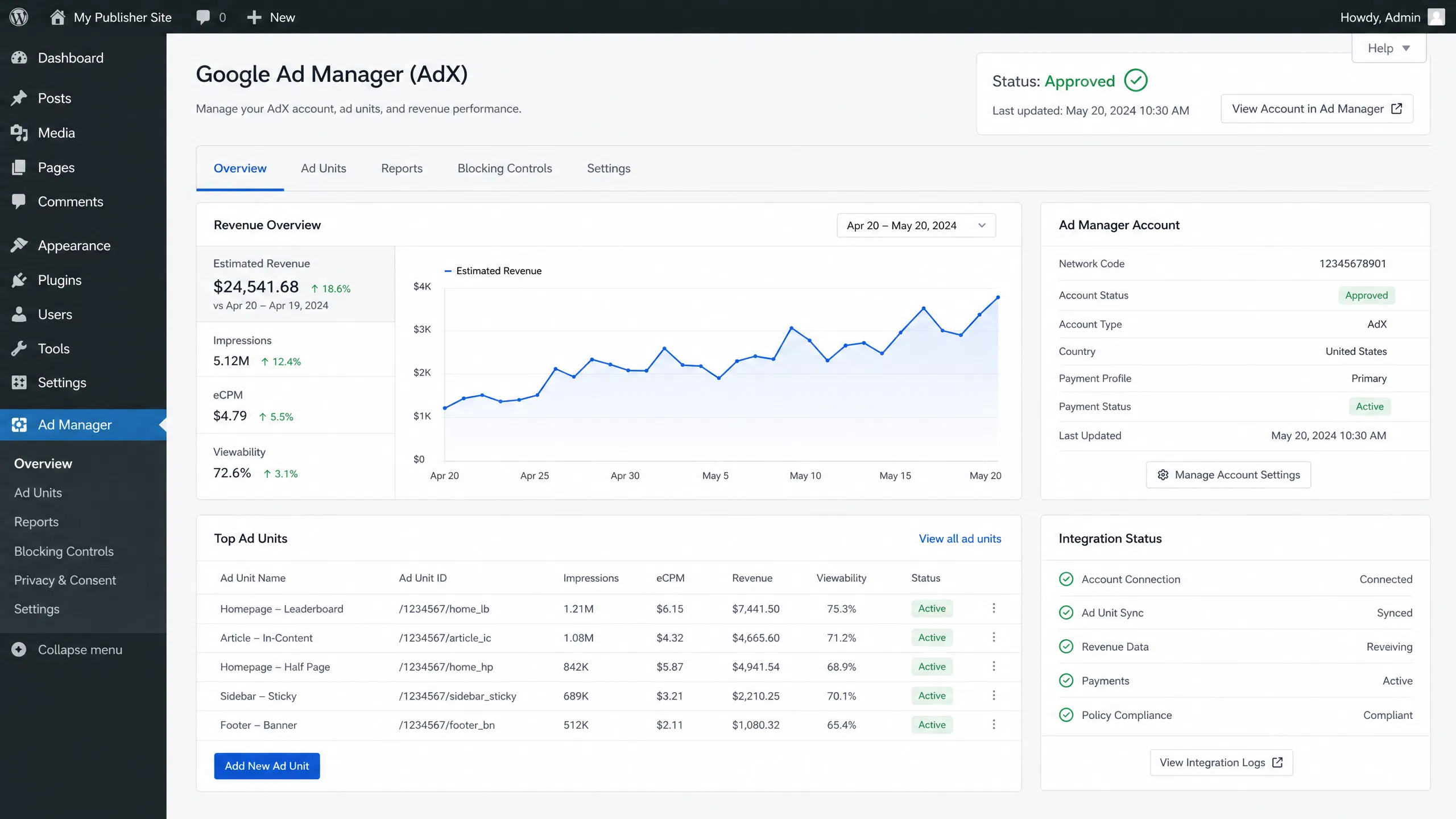
ADX is accessed and managed through Google Ad Manager. For WordPress users, plugins like Advanced Ads can simplify the integration of GAM ad units without extensive coding . This allows you to:
•Create Ad Units: Define various ad sizes and types (display, native, video) within GAM.
•Targeting: Utilize key-value targeting to deliver highly relevant ads based on post categories, tags, or user demographics.
•Responsive Ads: Implement responsive ad units that adapt to different screen sizes, ensuring optimal ad display across devices.

2. Dynamic Floor Pricing
One of the most powerful features of ADX is the ability to set dynamic floor prices. This allows you to specify the minimum price advertisers must bid for your ad impressions. By strategically adjusting floor prices, you can increase your eCPM and prevent your inventory from being sold too cheaply. Regularly review and optimize your floor prices to balance revenue and fill rates. For more insights, refer to articles on Adx Floor Price on adxapproval.com.
3. Header Bidding and Open Bidding
To further enhance competition, consider implementing header bidding or Google Open Bidding. These technologies allow multiple demand partners to bid on your inventory simultaneously, before the ad request even reaches GAM. This parallel auction environment significantly increases competition and can lead to higher revenues.
4. Ad Placement and User Experience
Strategic ad placement is crucial. While maximizing ad units might seem appealing, it can negatively impact user experience, leading to higher bounce rates and lower engagement. Aim for a balance:
•Above the Fold: Place high-performing ad units where they are immediately visible.
•In-Content Ads: Integrate ads naturally within your content, ensuring they don’t disrupt readability.
•Sticky Ads: Consider sticky ad units (e.g., footer ads) that remain visible as users scroll, but ensure they are not overly intrusive.
Always prioritize user experience. A positive UX leads to longer session durations and more page views, which ultimately benefits your ad revenue.
Common Pitfalls to Avoid with ADX for WordPress
Navigating the world of ADX for WordPress can be complex, and several common mistakes can hinder your progress or even lead to account issues. Being aware of these pitfalls can save you time and frustration.
•Ignoring Google’s Policies: AdX has strict content and traffic policies. Any violation can lead to account suspension. Regularly review Google Publisher Policies to ensure compliance.
•Low-Quality Content: As emphasized, thin or unoriginal content is a major red flag. Google prioritizes user value, and sites lacking this will struggle for approval and sustained performance.
•Invalid Traffic: Generating artificial traffic or using questionable traffic sources will quickly lead to penalties. Focus on legitimate, organic traffic growth.
•Poor Site Performance: A slow or non-responsive WordPress site frustrates users and negatively impacts ad viewability and engagement, which in turn affects ADX performance.
•Neglecting Optimization: Simply getting approved for ADX is not enough. Continuous optimization of ad placements, floor prices, and targeting is essential to maintain and grow revenue.
•Lack of Trust Pages: Missing crucial pages like “About Us” or “Privacy Policy” can signal a lack of trustworthiness to Google, impacting both AdSense and AdX approval. Refer to Google AdX Approval Requirements for more details.
Conclusion: Future-Proofing Your WordPress Monetization with ADX
Embracing ADX for WordPress is a strategic move for any publisher serious about maximizing their ad revenue in 2026 and beyond. While it demands a commitment to high-quality content, robust technical SEO, and a superior user experience, the rewards—significantly higher eCPMs, greater control, and access to premium demand—are substantial. By meticulously preparing your WordPress site, understanding the nuances of Google Ad Manager, and continuously optimizing your ad setup, you can unlock a powerful new stream of income. Remember, the journey to ADX is built on trust, traffic, and consistent quality. Start building that foundation today, and watch your WordPress monetization soar.