Navigating Google Ad Manager Approval: A Publisher’s Essential Guide
Meta Description: Master the Google Ad Manager approval process. This guide covers requirements, best practices, and steps to successfully get your Ad Manager account approved.
URL Slug: google-ad-manager-approval-guide
Table of Contents
1.Introduction to Google Ad Manager
2.Why Google Ad Manager Approval Matters
3.Understanding the Approval Ecosystem
4.Key Prerequisites for Ad Manager Approval
5.Content Quality and Policy Compliance
6.Technical Setup and Website Performance
7.Leveraging Google Certified Publishing Partners
8.Common Challenges and Solutions
9.Conclusion and Call to Action
1. Introduction to Google Ad Manager
Google Ad Manager (GAM) is a comprehensive ad management platform designed for large publishers with significant ad inventory and complex advertising needs. It unifies direct deals, programmatic demand, and third-party ad networks into a single, powerful platform. Gaining Google Ad Manager approval is a crucial step for publishers looking to centralize their ad operations, optimize revenue, and gain granular control over their ad inventory.
Unlike Google AdSense, which is primarily for smaller publishers, GAM offers advanced features such as sophisticated forecasting, detailed reporting, and the ability to manage multiple ad exchanges, including Google AdX. This robust platform empowers publishers to maximize their monetization potential by efficiently managing various ad formats and demand sources. The journey to Google Ad Manager approval requires a strategic approach, focusing on website quality, policy adherence, and technical readiness.
2. Why Google Ad Manager Approval Matters
For publishers serious about scaling their ad revenue and streamlining their operations, Google Ad Manager approval is indispensable. GAM provides unparalleled control over your ad stack, allowing you to prioritize direct-sold campaigns, manage programmatic deals, and integrate with various demand-side platforms (DSPs) and supply-side platforms (SSPs). This centralized management reduces operational overhead and helps prevent revenue leakage.
Beyond control, GAM offers advanced reporting and analytics capabilities, providing deep insights into ad performance, audience behavior, and revenue trends. These insights are vital for making data-driven decisions to optimize your ad strategy. Furthermore, Google Ad Manager approval often serves as a gateway to premium demand sources, including Google AdX, which can significantly boost your CPMs and overall earnings. It positions your website as a professional and reliable partner in the digital advertising ecosystem.
3. Understanding the Approval Ecosystem
The process for obtaining Google Ad Manager approval is intricately linked with Google’s broader advertising ecosystem. Publishers typically need to have an established presence and a track record of compliance with Google’s policies, often demonstrated through a previously approved Google AdSense account. Ad Manager is designed for publishers who have outgrown AdSense and require more sophisticated tools to manage their growing ad business.
The approval process involves a thorough review of your website to ensure it meets Google’s quality standards, content policies, and technical specifications. While direct applications are possible, many publishers find it beneficial to work with a Google Certified Publishing Partner (GCPP) to navigate the complexities. These partners can provide expert guidance and support, significantly increasing the likelihood of successful Google Ad Manager approval.
4. Key Prerequisites for Ad Manager Approval
Securing Google Ad Manager approval is contingent upon meeting several critical prerequisites. Foremost among these is a high-quality website with original, valuable content that attracts a substantial and legitimate audience. While specific traffic thresholds are not publicly stated, publishers generally need a significant volume of organic traffic to justify the use of GAM’s advanced features.
Your website must also strictly adhere to all of Google’s Publisher Policies, covering content, ad placement, and user experience. This includes avoiding prohibited content, ensuring ads are non-intrusive, and providing a transparent privacy policy. Technical readiness, such as proper site structure, fast loading times, and mobile responsiveness, is also crucial. A clean history with Google AdSense, free from policy violations, can also be a strong indicator of your site’s readiness for Google Ad Manager approval.
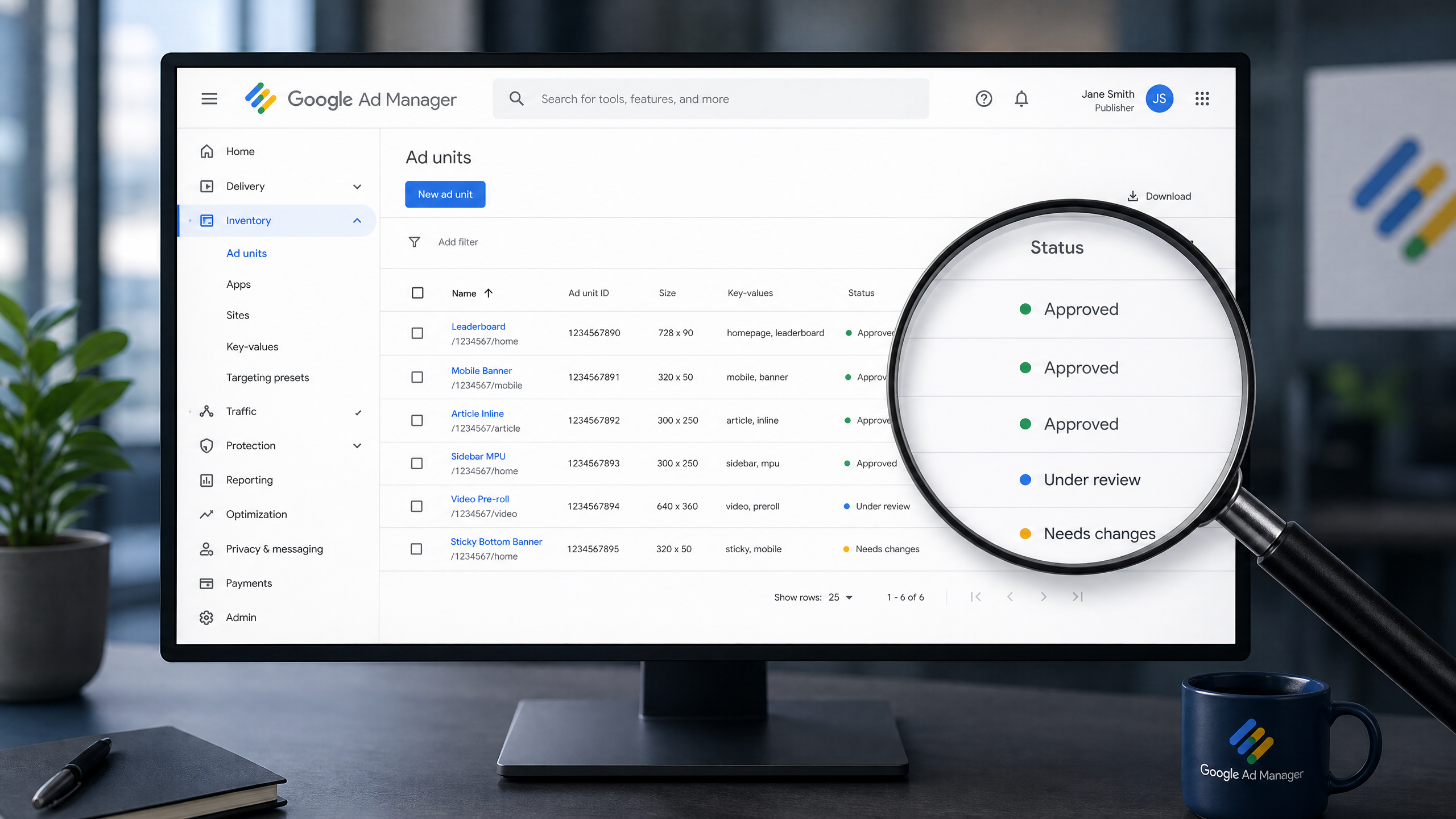
A professional illustration of the Google Ad Manager interface on a desktop monitor, with a magnifying glass symbolizing the review process.
5. Content Quality and Policy Compliance
At the heart of Google Ad Manager approval lies the unwavering commitment to content quality and strict policy compliance. Your website’s content must be original, informative, and engaging, providing genuine value to your visitors. Google places a high premium on unique content that is regularly updated and relevant to its audience. Websites with thin, scraped, or duplicate content are unlikely to receive approval.
Beyond quality, adherence to Google’s comprehensive Publisher Policies is non-negotiable. These policies prohibit certain types of content (e.g., illegal activities, hate speech, adult material) and dictate acceptable ad placement practices. Ads should not be misleading, interfere with user navigation, or encourage accidental clicks. A transparent and easily accessible privacy policy, compliant with regulations like GDPR and CCPA, is also essential for demonstrating your commitment to user privacy and securing Google Ad Manager approval.
6. Technical Setup and Website Performance
The technical foundation of your website is a critical factor in achieving Google Ad Manager approval. This includes ensuring your website is technically sound, loads quickly, and offers a seamless user experience across all devices. Google expects publishers to have a robust infrastructure capable of handling significant traffic and delivering ads efficiently.
Proper implementation of Google Publisher Tags (GPT) is paramount. These tags are responsible for fetching and rendering ads from Ad Manager, and any misconfigurations can lead to ad serving errors or lost revenue. Publishers should ensure their website is mobile-responsive, as a large portion of internet traffic now comes from mobile devices. Regular technical audits to identify and fix issues like broken links, slow page speeds, or server errors will demonstrate your site’s readiness for the demands of Ad Manager and contribute positively to your Google Ad Manager approval chances.
7. Leveraging Google Certified Publishing Partners
For many publishers, navigating the intricacies of Google Ad Manager approval can be a complex and time-consuming process. This is where Google Certified Publishing Partners (GCPPs) prove invaluable. These partners are recognized by Google for their expertise in ad monetization and their ability to help publishers optimize their ad operations and meet Google’s stringent requirements.
A GCPP can provide a comprehensive audit of your website, offering strategic recommendations to improve content, user experience, and technical setup. They often have direct lines of communication with Google, which can help expedite the approval process and resolve any potential issues more efficiently. Partnering with a GCPP can significantly increase your chances of successful Google Ad Manager approval, allowing you to leverage their expertise and focus on your core business of content creation.

A team of diverse professionals collaborating around a large screen displaying ad management statistics, symbolizing successful ad operations.
8. Common Challenges and Solutions
Publishers often face several challenges during the Google Ad Manager approval process. One common hurdle is insufficient traffic volume or quality, which can be addressed by focusing on organic growth strategies and improving user engagement. Another challenge is non-compliance with Google’s Publisher Policies, which requires a thorough review and remediation of any violating content or ad placements.
Technical issues, such as incorrect GPT implementation or slow website performance, can also delay approval. These can be resolved through diligent technical audits and optimization efforts. If your application is initially denied, carefully review the reasons provided by Google and address each point systematically. Persistence, a commitment to quality, and seeking expert guidance when needed are key to overcoming these challenges and ultimately achieving Google Ad Manager approval.
9. Conclusion and Call to Action
Achieving Google Ad Manager approval is a pivotal moment for publishers seeking to professionalize and scale their ad monetization efforts. It unlocks advanced features, greater control, and access to premium demand, ultimately leading to increased revenue. While the approval process is rigorous, focusing on high-quality content, robust traffic, strict policy compliance, and technical excellence will pave your way to success.
Start by thoroughly evaluating your website against Google’s guidelines. Prioritize creating an exceptional user experience and ensuring all technical aspects are in order. If you’re ready to elevate your ad management strategy and unlock the full potential of your ad inventory, consider pursuing Google Ad Manager approval. Take the first step today towards a more efficient and profitable advertising future!
YouTube Video: Google Ad Manager Account Approval Guide

GitHub Resources
For developers and publishers looking to integrate and optimize Google Ad Manager, the Google Publisher Tag (GPT ) samples on GitHub are an invaluable resource. These samples provide practical code examples and best practices for implementing ad tags, which is fundamental for successful Ad Manager operations.
•Google Publisher Tag Samples: https://github.com/googleads/google-publisher-tag-samples
References
Internal Link: To ensure your website is always performing at its best, delve into our guide on Website Development Best Practices for SEO and Monetization.