How to Optimize Adx Floor Price for Maximum Revenue: 7 Proven Strategies
Optimizing your floor price is one of the most effective and powerful ways to dramatically increase your programmatic ad revenue. Adx floor price optimization is a strategic approach that ensures publishers maximize their yield without sacrificing fill rates or long-term bidder relationships. In this comprehensive guide, we will explore the mechanics of floor pricing, the impact of the transition to first-price auctions, and actionable strategies you can implement today to boost your earnings.
 Table of Contents
What is Adx Floor Price Optimization?
In the world of programmatic advertising, a floor price (or reserve price) is the minimum amount a publisher is willing to accept for an ad impression. Adx floor price optimization is the practice of setting these minimum bids strategically to maximize revenue.
If your floor price is too low, you risk selling premium inventory at bargain rates, leaving money on the table. Conversely, if your floor price is too high, you may deter demand partners, leading to a significant drop in your fill rate. The goal of adx floor price optimization is to find the “sweet spot” where your inventory commands the highest possible price without driving away legitimate buyers.
For publishers using Google Ad Exchange (AdX), setting these rules effectively is critical. According to AdExchanger, setting price floors is necessary to properly signal the fair market value of a given impression. Only by setting the “right” floor for any given impression can you increase and not harm yield.
The Impact of First-Price Auctions on Floor Pricing
The digital advertising landscape underwent a massive shift when Google Ad Manager and most header bidding wrappers transitioned to first-price auctions. In a second-price auction, the winner paid just a penny more than the second-highest bid. This meant publishers could set low floor prices and still benefit from high bids.
In a first-price auction, the highest bidder pays exactly what they bid. This changed the dynamics entirely. Buyers began employing “bid shading” strategies to lower their bids to the estimated market value. Consequently, publishers must now use Adx floor price optimization to set floors that accurately reflect the true value of their inventory.
As noted in a study by Yahoo Advertising, optimizing floors in first-price auctions can deliver incremental revenue uplifts of over 1% for display and 2.5% for video . This highlights the importance of adapting your strategy to the current auction environment.
Types of Floor Prices
When implementing an adx floor price optimization strategy, publishers generally have three options:
1.Static Floor Prices: A fixed minimum bid that applies to all auctions. This is the simplest method but lacks flexibility.
2.Tiered Floor Prices: Different minimum bids are set based on specific criteria, such as device type (desktop vs. mobile), geography (tier 1 vs. tier 2 countries), or ad unit size.
3.Dynamic Floor Prices: The most advanced method, where algorithms adjust the floor price in real-time based on historical data, current demand, and user behavior.
For a deeper dive into setting these up, you can explore Google Ad Manager’s official documentation on pricing rules.
How to Build a Winning Adx Floor Price Optimization Strategy
Creating a successful strategy requires a data-driven approach. Here are the essential steps to building your floor pricing framework:
Understand Your Inventory Value
Not all ad inventory is created equal. A sticky 970×90 leaderboard on a desktop device is inherently more valuable than a 300×250 banner on a mobile device in a lower-tier country. You must analyze your historical performance data to establish a baseline target CPM for each of your ad units.
Monitor Fill Rates and Win Rates
When you raise your floor price, you must closely monitor your fill rate. If you see a sharp decline, your floor is likely too high, and buyers are unwilling to pay that premium. Conversely, if your fill rate is near 100% but your CPM is low, your floor is too low. The key to adx floor price optimization is constantly adjusting these levers to find the optimal balance.
Leverage Data-Driven Insights
Use A/B testing to experiment with different floor prices. For example, you might test a $1.00 floor against a $1.25 floor for a specific ad unit in the United States. Measure the total revenue (RPM) to determine which floor price generated more income, rather than just looking at the average CPM.
Dynamic vs. Static Floor Prices
While static floors are easy to implement, dynamic floors are becoming the industry standard for serious adx floor price optimization.
Dynamic floor pricing uses machine learning algorithms to assess the value of a specific impression in real-time. Factors such as the time of day, user engagement history, and current bid density are analyzed to set a unique floor for that exact auction.
According to TensorOps, dynamic floor optimization is critical in first-price auctions. Their research shows that treating every ad request as an isolated auction is less effective than modeling the entire user session, allowing for sequential price discovery that lifts CPM without breaking demand.
 Seasonal Adjustments for Maximum Yield
Your adx floor price optimization strategy should not be static throughout the year. Advertising spend fluctuates significantly based on seasons and events.
•Q4 Holiday Season (October – December): Advertisers increase their budgets to capture holiday shoppers. Demand is high, making this the perfect time to raise your floor prices.
•Q1 Post-Holiday Slump (January – March): Many companies cut their ad spend after the holidays. Lowering your floor prices during this period can help maintain fill rates and prevent a steep decline in revenue.
By adapting to these seasonal trends, you ensure that you are capturing maximum value when demand is high and maintaining volume when demand is low.
Google Ad Manager and Prebid Setup
Implementing your floors requires configuring the platforms you use for monetization.
Setting Floor Prices in Google Ad Manager
In Google Ad Manager (formerly DFP), you can create Unified Pricing Rules (UPRs) to set floors.
1.Navigate to Inventory > Rules > Unified Pricing Rules.
2.Click + New Unified Pricing Rule.
3.Set your targeting criteria (e.g., specific ad units, devices, or countries).
4.Input your minimum CPM (your floor price).
5.Save the rule.
Note: Google Ad Manager limits non-360 accounts to 100 custom rules and 360 accounts to 200 custom rules.
Setting Floor Prices in Prebid
For header bidding wrappers like Prebid.js, you can use the setConfig function to establish floors.
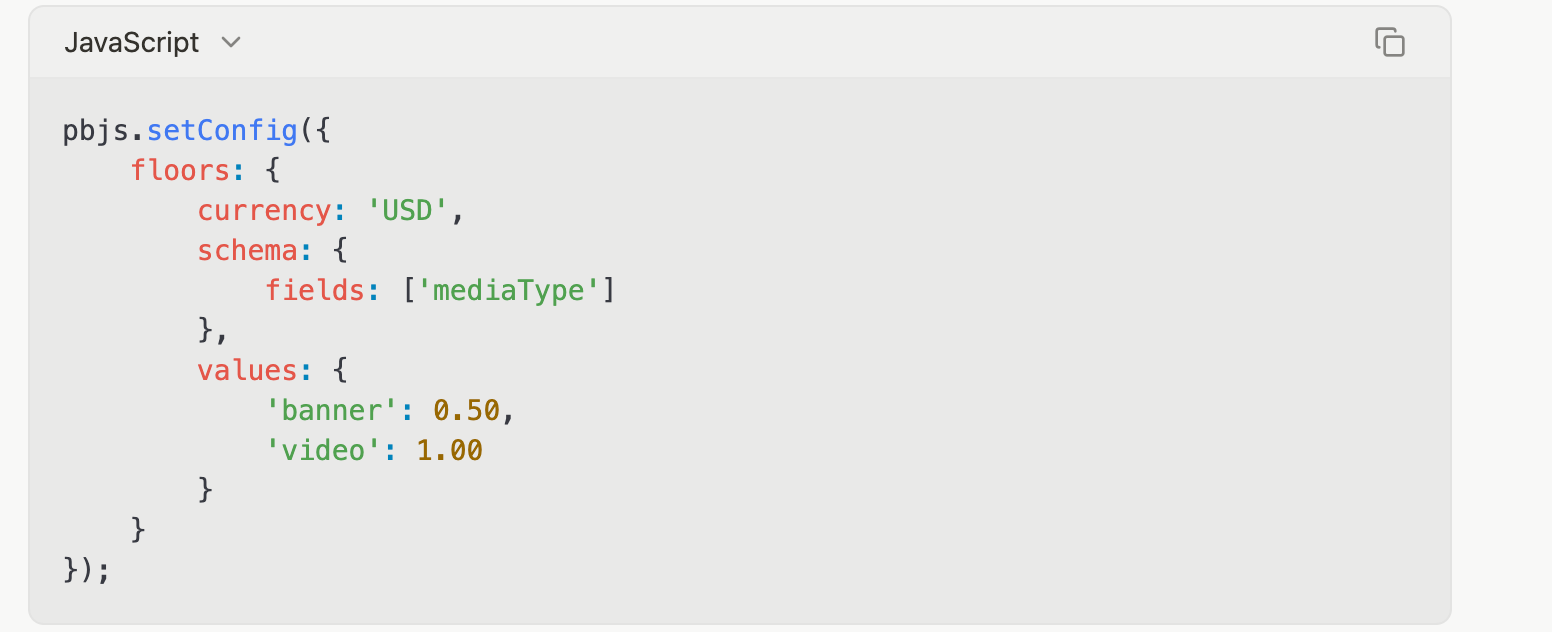
This code sets a $0.50 floor for banners and a $1.00 floor for video ads. Prebid allows for highly granular control, including floors based on domain, size, and geo. For more advanced techniques, check out this guide on building target CPM strategies.
Measuring Success: Key Metrics
How do you know if your adx floor price optimization efforts are working? You need to track the right metrics.
|
Metric
|
Description
|
Goal
|
|
Revenue Per Mille (RPM)
|
The amount of revenue generated per 1,000 impressions.
|
Increase RPM overall.
|
|
Fill Rate
|
The percentage of ad requests that result in a sold impression.
|
Maintain a healthy fill rate (typically 70-85%).
|
|
Average CPM
|
The average cost per 1,000 impressions sold.
|
Increase CPM without drastically dropping fill rate.
|
|
Bid Win Rate
|
The percentage of bids from demand partners that meet your floor price.
|
Optimize to keep bidders engaged.
|
If your CPM increases by 20% but your fill rate drops by 40%, your overall RPM will decrease. The goal is to increase RPM, which is a function of both CPM and fill rate.
Conclusion
Mastering Adx floor price optimization is essential for any publisher looking to maximize their programmatic revenue. By understanding the mechanics of first-price auctions, leveraging dynamic pricing models, and continuously testing your strategies, you can find the perfect balance between high CPMs and strong fill rates. Remember that this is an ongoing process—market conditions change, and your floor prices must adapt accordingly.
Frequently Asked Questions
What is the ideal floor price for AdX?
There is no single ideal floor price. It varies based on your niche, traffic quality, geography, and ad unit placement. The best way to find your ideal floor is through continuous A/B testing and monitoring your RPM.
Does raising the floor price increase revenue?
Not necessarily. Raising the floor price increases your average CPM, but it will also decrease your fill rate. You only increase total revenue if the gain in CPM outweighs the loss in volume.
How often should I adjust my floor prices?
You should review your floor price performance weekly. However, automated dynamic floor price tools can adjust bids on a per-impression basis, ensuring you are always capturing optimal value.