7 Powerful Mobile App Monetization Platforms for 2026: Skyrocket Your Revenue
Unlocking Revenue with Mobile App Monetization Platforms
In the dynamic world of mobile applications, simply creating a great app is no longer enough. To thrive, developers and businesses must master the art of generating sustainable revenue. This is where mobile app monetization platforms become indispensable. These powerful tools and services enable app creators to convert their user base into a consistent income stream, transforming free app installs into profitable ventures.
As we navigate 2026, the landscape of app monetization is evolving rapidly, driven by advancements in artificial intelligence, new device form factors like foldables, and an increasing emphasis on user privacy. Understanding and leveraging the right monetization strategies and platforms is crucial for any app looking to achieve significant financial success.
This comprehensive guide will delve into the core concepts of mobile app monetization, explore the leading platforms that are shaping the industry, and highlight the emerging trends that will define success in the coming years. By the end of this article, you will have a clear roadmap to selecting the best mobile app monetization platforms to skyrocket your app’s revenue.
Table of Contents
What are Mobile App Monetization Platforms?
Mobile app monetization platforms are specialized services and technologies designed to help app developers generate revenue from their applications. These platforms provide the necessary tools, infrastructure, and expertise to implement various monetization strategies, such as in-app advertising, in-app purchases, and subscriptions. They act as intermediaries, connecting app publishers with advertisers, payment gateways, and analytics tools to optimize revenue streams.
In essence, these platforms simplify the complex process of turning user engagement into profit. They offer features like ad mediation, programmatic bidding, analytics dashboards, and compliance support, allowing developers to focus on creating compelling user experiences while the platform handles the intricacies of revenue generation.
Key Mobile App Monetization Strategies
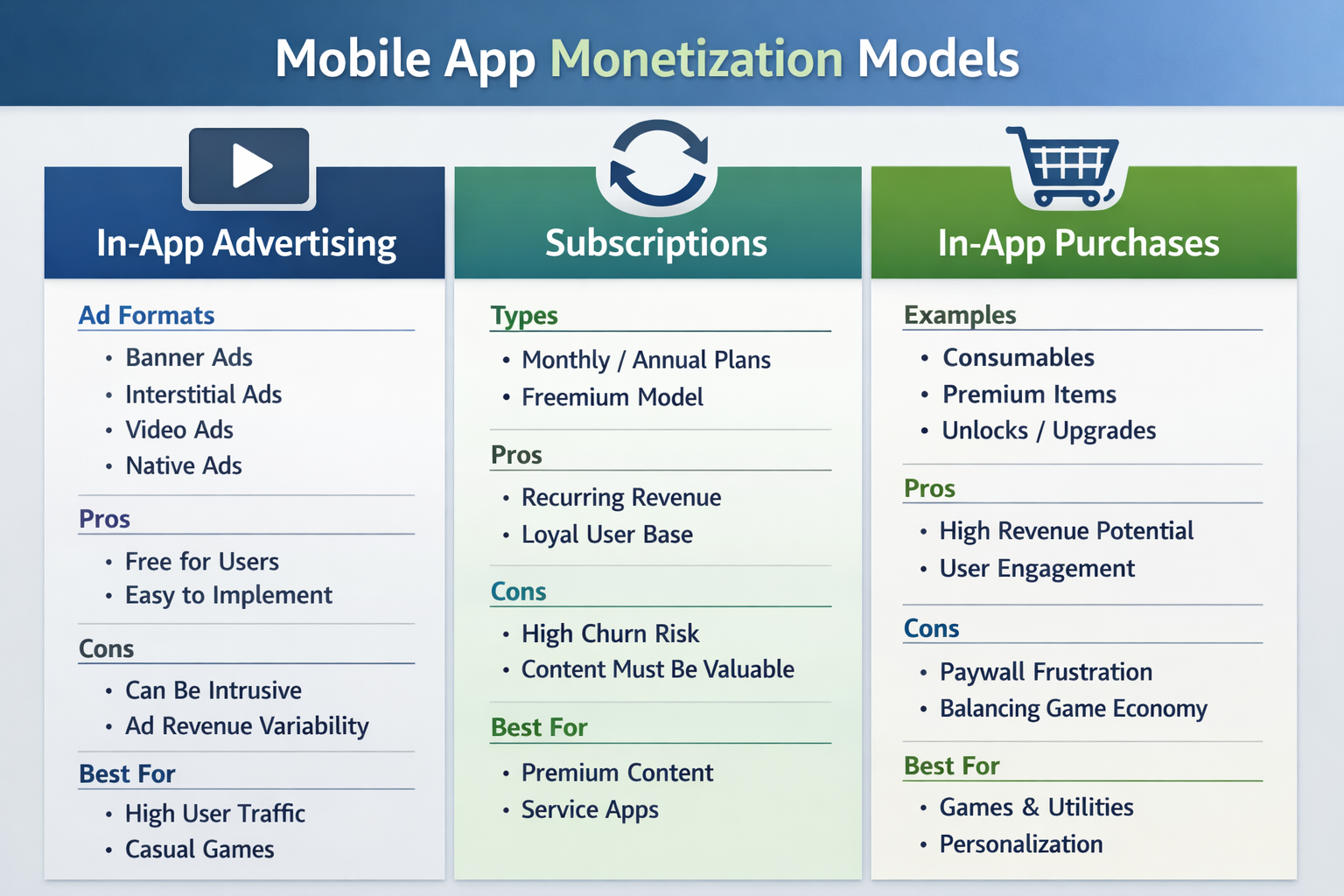
Before diving into specific mobile app monetization platforms, it’s essential to understand the primary strategies employed to generate revenue. Most successful apps utilize a combination of these models, often referred to as hybrid monetization.
In-App Advertising (IAA)
In-App Advertising remains one of the most prevalent monetization methods. It involves displaying various ad formats within the app interface. The effectiveness of IAA heavily relies on integrating ads seamlessly without disrupting the user experience. Common ad formats include:
•Banner Ads: Small, rectangular ads displayed at the top or bottom of the screen.
•Interstitial Ads: Full-screen ads that appear at natural breaks in the app’s flow.
•Rewarded Video Ads: Users opt-in to watch a video ad in exchange for in-app rewards (e.g., extra lives, virtual currency).
•Native Ads: Ads designed to blend in with the app’s content and user interface, making them less intrusive.
IAA is particularly effective for apps with a large, active user base, especially in the gaming and utility sectors. The key is to balance ad frequency and placement to maximize revenue without alienating users.
In-App Purchases (IAP)
In-App Purchases allow users to buy virtual goods, premium features, or additional content directly within the app. This model is highly popular in gaming, where users might purchase virtual currency, character upgrades, or cosmetic items. For non-gaming apps, IAP can include unlocking advanced features, removing ads, or buying digital content.
IAP thrives on providing tangible value to users, encouraging them to spend money to enhance their experience or gain an advantage. A well-designed IAP strategy can significantly boost revenue, especially when coupled with a strong user engagement model.
Subscriptions
Subscription models offer recurring revenue by charging users a regular fee (weekly, monthly, annually) for access to premium content, exclusive features, or an ad-free experience. This model is increasingly adopted by content-heavy apps, productivity tools, and streaming services.
Subscriptions foster a loyal user base and provide predictable revenue streams. The freemium model, where basic features are free and advanced features require a subscription, is a popular variation that allows users to experience the app’s value before committing to a payment.
Hybrid Monetization Models
The most effective strategy for many apps in 2026 is a hybrid approach, combining elements of IAA, IAP, and subscriptions. This allows apps to cater to different user preferences and maximize revenue potential. For example, an app might offer a free version with ads and limited features, an IAP to remove ads, and a premium subscription for all features plus exclusive content.

Top 7 Mobile App Monetization Platforms in 2026
Choosing the right mobile app monetization platforms is critical for success. Here are seven leading platforms that offer robust solutions for developers in 2026:
1. Google AdMob
Google AdMob is a powerhouse in mobile advertising, offering a comprehensive suite of tools for monetizing apps through various ad formats. As part of the Google ecosystem, it provides unparalleled global reach and access to a vast network of advertisers. AdMob is known for its ease of integration, robust reporting, and optimization features that help developers maximize their ad revenue .
Key Features:
•Wide range of ad formats: banner, interstitial, rewarded video, native.
•Global demand from Google’s extensive advertiser network.
•Mediation capabilities to optimize ad revenue from multiple sources.
•Detailed analytics and reporting.
Best For: Apps seeking broad reach, diverse ad formats, and seamless integration with other Google services.
2. Meta Audience Network
Meta Audience Network (formerly Facebook Audience Network) excels in delivering highly personalized ads by leveraging Meta’s extensive user data. This platform allows advertisers to extend their Facebook and Instagram campaigns into mobile apps, resulting in high-quality ad demand and better eCPMs for publishers. It’s particularly strong for apps whose audience aligns with Meta’s demographic data .
Key Features:
•Access to Meta’s vast advertiser base and targeting capabilities.
•High fill rates and competitive eCPMs.
•Support for native, interstitial, and rewarded video ads.
•Strong personalization for relevant ad delivery.
Best For: Apps looking for highly targeted advertising and strong performance in social-centric demographics.
3. Unity Ads
Unity Ads is a leading monetization platform specifically designed for mobile games. Integrated directly into the Unity game engine, it offers seamless implementation for game developers. Unity Ads is renowned for its rewarded video ads, which are highly effective in gaming contexts, providing players with in-game incentives for watching ads .
Key Features:
•Deep integration with the Unity game engine.
•Specialization in rewarded video and interstitial ads for games.
•Strong performance metrics for game developers.
•User acquisition tools alongside monetization.
Best For: Mobile game developers seeking high-performing ad solutions tailored for gaming experiences.
4. AppLovin
AppLovin is a comprehensive mobile technology company that offers both monetization and user acquisition solutions. Its MAX mediation platform helps developers optimize their ad revenue by dynamically managing multiple ad networks. AppLovin’s robust platform is designed to drive growth for mobile apps through advanced analytics and powerful optimization algorithms .
Key Features:
•MAX mediation platform for intelligent ad network management.
•Extensive demand sources and high eCPMs.
•Powerful user acquisition and analytics tools.
•Focus on driving app growth and revenue.
Best For: Developers looking for an all-in-one platform for both monetization and user acquisition, especially in the gaming sector.
5. InMobi
InMobi is a global mobile advertising platform known for its AI-driven optimization and focus on native ad experiences. It offers a programmatic ad exchange that allows app developers to monetize their apps with high-definition video and native ads that blend seamlessly with the app’s design. InMobi’s rewarded video format is also a strong offering, providing engaging ad experiences .
Key Features:
•AI-driven optimization for maximizing revenue.
•High-definition video and native ad formats.
•Global reach and diverse demand sources.
•Non-intrusive ad experiences.
Best For: Apps prioritizing native ad integration, AI-powered optimization, and global audience reach.
6. PubMatic
PubMatic provides a sophisticated programmatic mobile advertising platform that enables publishers to monetize their content effectively. It offers an open exchange and advanced models to maximize monetization through various integration types, including SDK and non-SDK options. PubMatic is a strong choice for publishers looking for robust programmatic solutions and dedicated account support .
Key Features:
•Leading programmatic technology with parallel auctions.
•Flexible integration options (SDK and non-SDK).
•Dedicated account management and support.
•Focus on maximizing publisher revenue through advanced ad tech.
Best For: Publishers and app developers seeking advanced programmatic advertising solutions and strong support.
7. Paddle
Paddle stands out as a unique mobile app monetization platform, particularly for SaaS and subscription-based apps. It acts as a Merchant of Record, handling all aspects of global payments, taxes, compliance, and subscriptions. This significantly reduces the operational burden on developers, allowing them to focus on product development rather than payment infrastructure .
Key Features:
•Merchant of Record services: handles global sales tax, VAT, and compliance.
•Subscription management and billing.
•Fraud protection and payment processing.
•Localization and global payment support.
Best For: SaaS apps, subscription-based services, and developers needing comprehensive payment and compliance management.
Emerging Trends in Mobile App Monetization for 2026
The future of mobile app monetization platforms is being shaped by several key trends that developers must consider to stay competitive and profitable.
AI-Native Features and Personalization
Artificial intelligence is increasingly integrated into monetization strategies. AI-native features enable hyper-personalization of ad content and offers, predicting user behavior to deliver the most relevant monetization opportunities. This leads to higher engagement rates and increased revenue, while also improving the user experience by showing more desirable content.
Optimization for Foldable Devices
With the rise of foldable smartphones, app developers have new opportunities to innovate monetization. These devices offer larger, dynamic screen real estate, allowing for new ad formats and interactive experiences. Platforms that can adapt to and leverage these unique form factors will gain a significant advantage.
Privacy-First Monetization Approaches
User privacy continues to be a paramount concern, leading to stricter regulations and platform changes (e.g., Apple’s ATT, Google’s Privacy Sandbox). Mobile app monetization platforms are evolving to offer privacy-preserving solutions that balance revenue generation with user trust and compliance. This includes contextual advertising, first-party data strategies, and advanced anonymization techniques.
Choosing the Right Mobile App Monetization Platform
Selecting the ideal mobile app monetization platform depends on several factors, including your app’s genre, target audience, business model, and desired level of control. Consider the following when making your decision:
•App Type: Is it a game, a utility, a content app, or a SaaS product?
•Monetization Strategy: Do you primarily rely on ads, IAP, subscriptions, or a hybrid model?
•Audience Demographics: Where are your users located, and what are their spending habits?
•Integration Effort: How easy is the platform to integrate with your existing tech stack?
•Support and Analytics: Does the platform offer robust reporting and dedicated support?
•Compliance: Does it help with global tax and privacy regulations?
By carefully evaluating these aspects, you can choose a platform that aligns with your app’s unique needs and maximizes its revenue potential.
Conclusion: Mastering Mobile App Monetization for Sustainable Growth
Navigating the complex world of app monetization requires strategic planning and the right tools. By understanding the various monetization strategies and leveraging the capabilities of leading mobile app monetization platforms, developers can build sustainable and highly profitable applications. The future of app revenue is bright for those who embrace innovation, prioritize user experience, and adapt to emerging trends like AI-driven personalization and privacy-first approaches.
Invest time in researching and implementing the platforms discussed in this guide, and you’ll be well on your way to transforming your mobile app into a significant revenue generator in 2026 and beyond.