10+ Powerful Ways to Skyrocket Your Website RPM in 2026
Introduction: Unlocking Higher Website RPM
In the dynamic world of online publishing and content creation, understanding how to increase website RPM is paramount for maximizing your digital revenue. RPM, or Revenue Per Mille (Mille being Latin for thousand), is a critical metric that measures the estimated earnings you receive for every thousand page views your website generates. A higher RPM directly translates to more income from your ad inventory, making it a key focus for publishers aiming for sustainable growth and profitability. This comprehensive guide will delve into the core concepts of website RPM, its calculation, influencing factors, and, most importantly, provide over 10 powerful, actionable strategies to significantly boost your website’s RPM in 2026 and beyond.
What is Website RPM?
Website RPM, often referred to as Page RPM, is a key performance indicator (KPI) for publishers and website owners. It represents the estimated revenue generated per one thousand page views. This metric provides a holistic view of your website’s monetization efficiency, taking into account various factors like ad impressions, click-through rates (CTR), and cost-per-click (CPC) or cost-per-thousand-impressions (CPM) rates. While Google AdSense commonly uses Page RPM, it’s essential to distinguish it from Session RPM (revenue per thousand sessions) and Impression RPM (revenue per thousand ad impressions), as each offers a different perspective on your site’s earning potential [1].
How is Website RPM Calculated?
The calculation for Website RPM is straightforward:
Website RPM = (Estimated Earnings / Number of Page Views) * 1000
For example, if your website generates $2,000 in estimated ad earnings from 250,000 page views, your RPM would be:
($2,000 / 250,000) * 1000 = $8
This means your website earns $8 for every thousand page views. It’s crucial to use gross ad revenue before any deductions for this calculation to get an accurate picture of your ad inventory’s performance [1].
Factors Influencing Website RPM
Several interconnected factors directly impact your website’s RPM:
•Click-Through Rate (CTR): The percentage of ad impressions that result in a click. A higher CTR indicates more engaging and relevant ads, leading to increased earnings and, consequently, a higher RPM [2].
•Cost Per Click (CPC): The amount an advertiser pays for each click on their ad. CPC varies based on ad content, context, audience targeting, and niche. Higher CPCs contribute directly to a better RPM [2].
•Ad Viewability: The percentage of ads that are actually seen by users. Ads that are viewable for a longer duration or appear in prominent positions tend to have higher CPMs and better performance, boosting RPM [2].
•Traffic Quality and Relevance: Attracting visitors who are genuinely interested in your content and the ads displayed on your site significantly improves engagement and conversion rates, leading to higher RPMs [1].
•Ad Formats and Sizes: Different ad types (display, video, native) and sizes perform differently. Optimizing these can lead to better user engagement and higher revenue [1].
•User Experience (UX) and Site Speed: A fast, user-friendly website encourages longer visits and more page views, increasing the chances of ad interactions. Poor UX or slow loading times can drive users away, negatively impacting RPM [2].
•Seasonality and Market Dynamics: Ad market demand fluctuates throughout the year (e.g., higher in Q4 due to holidays). Understanding these trends helps contextualize RPM performance [1].
10+ Proven Strategies to Increase Website RPM
To truly increase website RPM, a multi-faceted approach is required, focusing on both ad optimization and overall site health. Here are actionable strategies:
Optimize Ad Formats and Sizes
Experiment with various ad formats beyond standard display ads. Video ads, native ads, and interactive rich media ads often yield higher engagement and, consequently, better RPMs due to their immersive nature. Similarly, ad sizes matter. Larger, more prominent ad units like leaderboards (728×90) or large rectangles (336×280) often command higher CPMs. However, balance this with user experience; overly intrusive ads can deter visitors. A/B testing different formats and sizes is crucial to find the optimal balance for your audience [1].
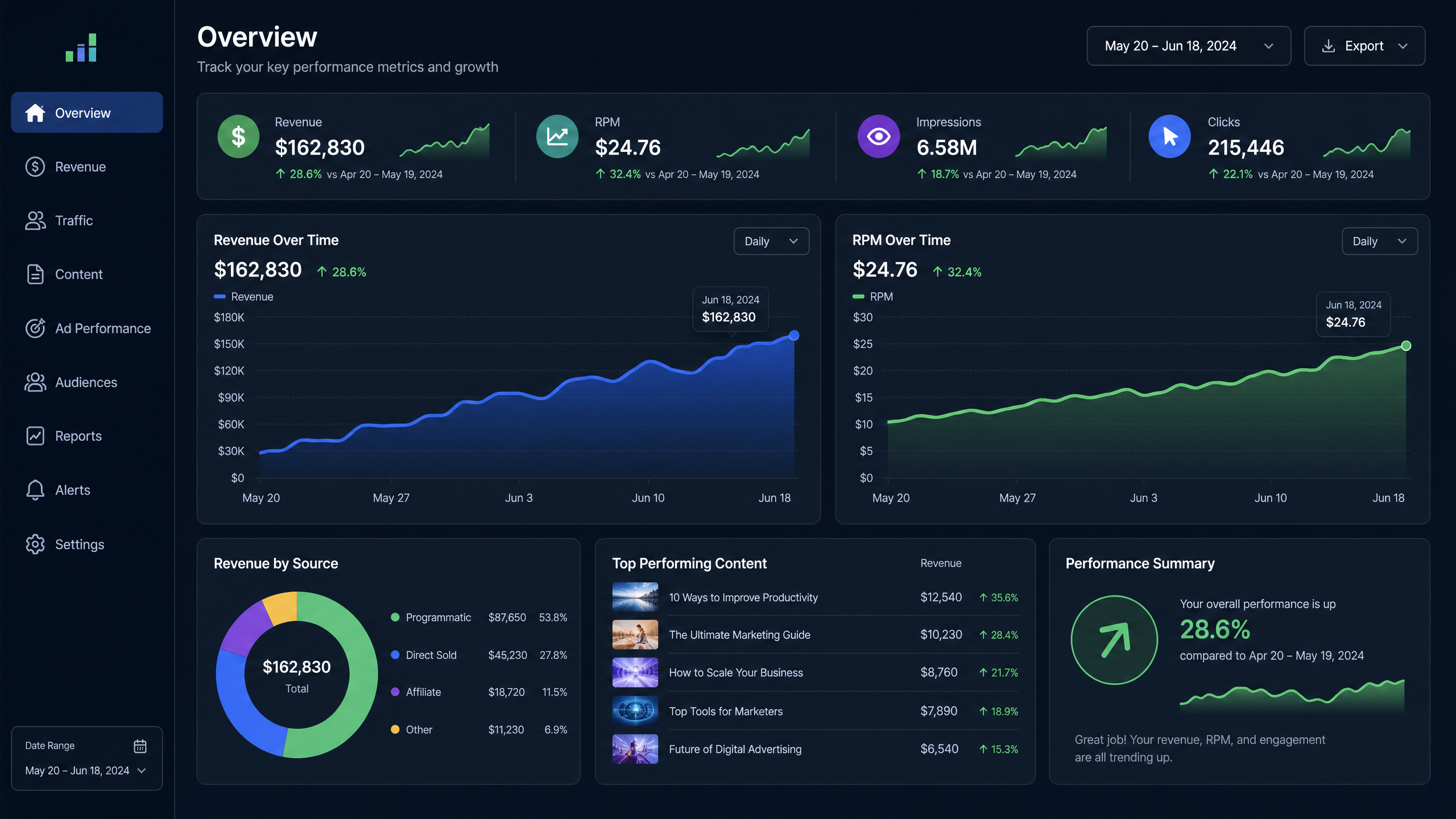
Alt text: Digital marketing dashboard showing increasing RPM metrics
Implement Smart Ad Refresh
Ad refresh allows you to display multiple ads within the same ad slot during a user’s visit, refreshing the ad creative when certain conditions are met (e.g., user scrolls, time on page). While AdSense has restrictions, partnering with ad networks or using Google Ad Exchange can enable smart ad refresh. This strategy can significantly boost impression RPM without increasing the number of ad units, provided the refresh is viewability-driven and user-engagement-aware [1].
Attract High-Quality Traffic
Focus on attracting visitors who are genuinely interested in your content. High-quality, engaged traffic is more likely to interact with relevant ads, leading to higher CTRs and CPCs. Organic search, direct traffic, and targeted social media campaigns often bring in more valuable users than generic, untargeted traffic sources. Analyze your traffic sources to identify those that yield the highest RPM and prioritize them [2].
Enhance User Experience (UX)
A superior user experience is foundational to higher RPM. Websites with intuitive navigation, clean design, and minimal distractions encourage longer sessions and more page views. Avoid excessive ads that overwhelm users or disrupt content consumption. Strive for a balance where ads complement the content rather than detract from it. Metrics like bounce rate, session duration, and repeat visitors can indicate UX quality [2].
Improve Content Quality and Relevance
High-quality, valuable, and relevant content is the magnet that attracts and retains high-value users. When users find your content useful, they spend more time on your site, explore more pages, and are more receptive to ads. Regularly update evergreen content, create in-depth articles, and ensure your content addresses user intent effectively. This not only boosts organic traffic but also increases the likelihood of ad engagement [2].
Leverage Header Bidding
Header bidding is an advanced programmatic advertising technique that allows multiple ad exchanges and demand-side platforms (DSPs) to bid simultaneously for your ad inventory before the page loads. This creates greater competition among advertisers, driving up CPMs and ultimately increasing your website RPM. Unlike the traditional waterfall model, header bidding ensures you always get the highest possible price for each ad impression [2].
Partner with Reputable Ad Networks
Diversifying your ad partners beyond a single network can significantly improve your fill rate and RPM. Reputable ad networks have access to a wider pool of advertisers and can offer better CPMs for specific niches or audience segments. Look for partners that offer transparent reporting, strong optimization tools, and a good track record of publisher success [2].
Optimize Ad Placements and Layouts
Strategic ad placement is crucial. Ads should be placed where they are highly visible without being overly intrusive. Common high-performing placements include above the fold, within content (native ads), and sticky sidebars or footers. Experiment with different layouts and positions to find what works best for your site’s design and audience behavior. Wider ad sizes generally perform better due to increased visibility [2].
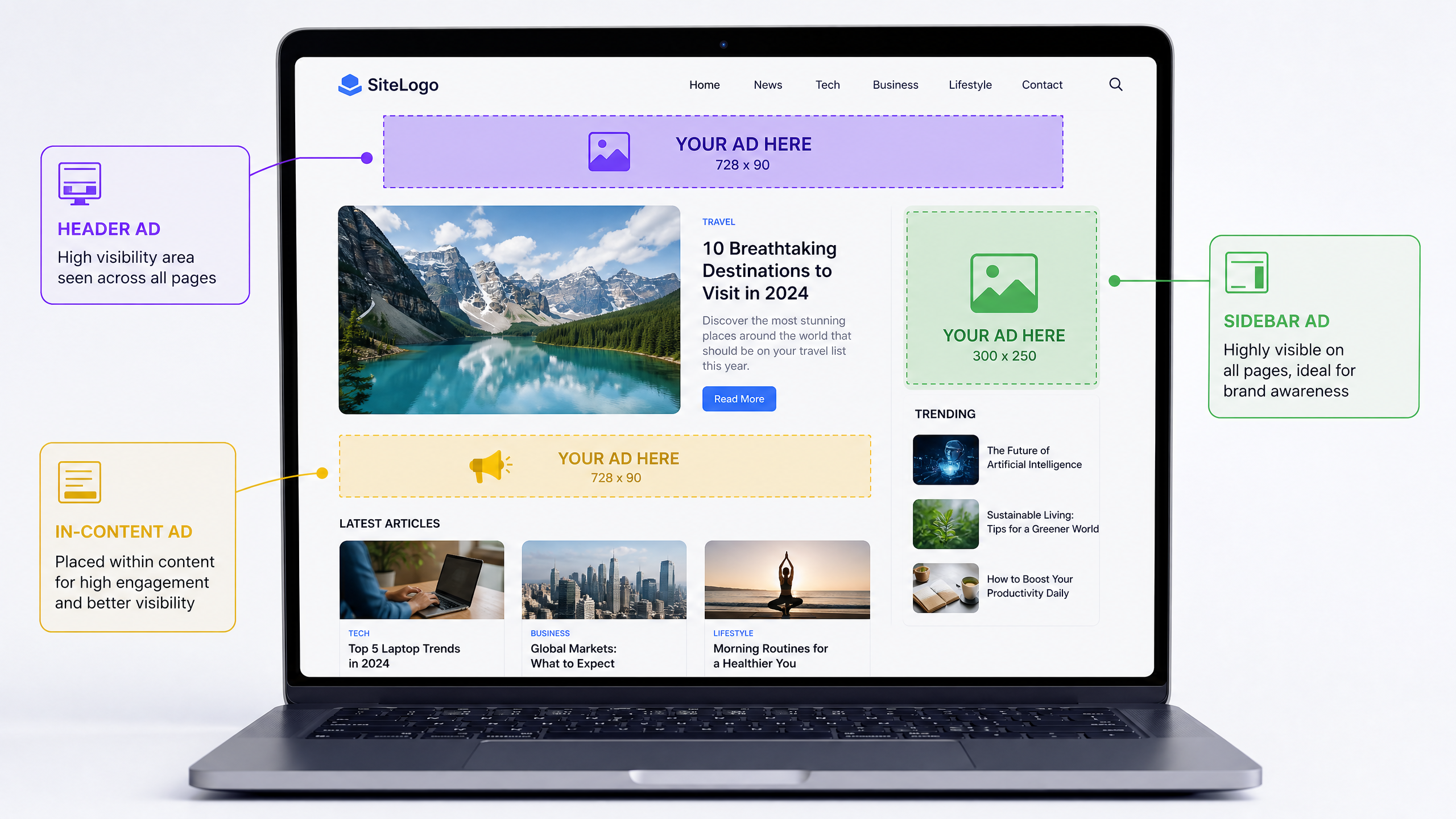
Alt text: Website layout showing optimal ad placement areas
Utilize Google Ad Manager
For publishers with substantial traffic (e.g., over 200,000 page views), Google Ad Manager (GAM) offers advanced control over ad inventory. GAM allows you to manage direct deals, integrate multiple ad networks, and implement sophisticated targeting and optimization strategies. It acts as a unified platform to maximize revenue by ensuring that ad slots are always filled by the highest bidder, whether from direct campaigns or programmatic sources [2].
Combat Invalid Traffic
Invalid traffic (IVT), including bot traffic and fraudulent clicks, can severely depress your RPM and even lead to penalties from ad networks. Implement robust anti-fraud measures and regularly monitor your traffic analytics for suspicious activity. Focusing on legitimate, human traffic ensures that your ad impressions are valuable to advertisers, leading to higher bids and better RPMs [2].
Boost Site Speed
Website loading speed is a critical factor for both user experience and SEO, indirectly impacting RPM. Faster loading times reduce bounce rates, increase page views per session, and improve ad viewability. Optimize images, leverage browser caching, use a Content Delivery Network (CDN), and minimize render-blocking resources to ensure your site loads quickly across all devices [2].

Alt text: Diverse group of people engaging with digital content, representing user engagement
Monitoring and Continuous Optimization
Increasing website RPM is not a one-time task but an ongoing process. Regularly monitor your RPM, CTR, CPC, and other relevant metrics using tools like Google AdSense, Google Analytics, or specialized ad optimization platforms. Analyze trends, identify underperforming pages or ad units, and continuously A/B test new strategies. The digital advertising landscape is constantly evolving, so staying agile and data-driven is key to sustained RPM growth [1].
Conclusion: How to increase website rpm
Mastering how to increase website RPM is essential for any publisher looking to thrive in the digital economy. By strategically optimizing ad formats and placements, attracting high-quality traffic, enhancing user experience, and leveraging advanced ad technologies like header bidding and Google Ad Manager, you can significantly boost your ad revenue. Remember, consistency in content quality and a commitment to continuous monitoring and optimization will pave the way for unparalleled success and a truly powerful website monetization strategy in 2026.